Pages

Thursday, April 28, 2011

Travels and Tastes - Scotland

I sometimes leave a piece of my heart in places I visit, places that touch me on a some kind of a deeper level, whether reminding me of something long forgotten or summoning me to come back to discover something not yet found.  I left a wee bit of my heart in Scotland.  I was mesmerized by the sheer beauty of the countryside, the rolling hills and planes of Low-lands, the gorgeous mountainside and lochs of the High-lands, the rolling rivers and streams, the fertile, rich farm land…  Granted, the weather helped, we managed to hit a whole week worth of un-Scottish like weather.  The warm spring sun glistening of the green fields, filled with either grazing grass or bright yellow of canola flowers.  The wild flowers everywhere, the flowering fruit trees and the beautiful English gardens beyond the hedge of every cottage, seems unreal, almost fairy tale like.  The ruins of castles set upon the most picturesque of lakes, made me think of fairy maidens and their white-horsed knights.  Having grown up on legends of the medieval kind, I had imagined Scotland in a certain way; it was exactly how I pictured it and even better, because it was real. 


All the sheep deserve a special note.  During early spring it is lambing season, and Scotland’s sheep population explodes to twelve million.  Mind you, there are only about three million Scotts.  The sheep are everywhere, each meadow, field or a green patch of grass is a grazing ground for them.  They are like little white clouds set alone the landscape.  The little lambs, barely standing, are trailing alone after their mothers.  Do I need to mention that Scottish lamb is most prized and tastes nothing of the lamb that I have tasted before?  Free to graze on the fields, basking in the sunshine from morning to dusk, sheaparded only by border collies, these are indeed the tastiest lambs in the world.


Sheep are not the only ones enjoying the good life in Scotland; cows are free to roam the fields as well.  The long haired High-land breeds as well as plain cattle play out the Happy Cow commercial right in front of your eyes, naturally, the steaks and burgers taste a lot better than the ones you would encounter at your local market. 
The Scottish food staples consist of fresh seafood coming each morning directly from the lochs (Gaelic for lake) and the North Sea, lamb prepared each and every way imaginable, steak, beef cheeks and haggis.  The prized salmon is all you would expect it to be and so are the scallops and the haddock.  I sampled some of the fresh river trout and it was buttery and slightly pink in the flesh.  Lamb is delicious and tender and cooked rear in most places. 

Having earned a scary reputation with Americans, haggis is nothing to fear of; it is perfectly delicious if you don’t think too much of what is in it. Someone having strong aversions to internal organs should probably stay away from it, but if you are open minded enough, there is nothing more satisfying on a chilly day. 
The food is somewhat heavy, meant to ward of the bone chill and dampness of typical Scottish weather.   Of course it needs to be washed down with whisky, Scotch to be exact.  For a tourist, such as me a proper Scotch tasting lesson is a must.  I now know that four different Scotch producing regions manage very distinct tasting whiskies, from smoky varieties of the west to citrusy and fruity varieties of the north and south.  We attended a whisky tasting sessions which can only be compared to the intricacies of tasting wine.  After seeing a 3,500 bottle single largest collection of whisky in Edinburgh and having a private tasting at tiny shop in a one-horse village by the loch, I might just become a convert. 
Some of the most memorable dishes included a wild rabbit terrine and venison cooked to perfection.  Fish and chips takes on a different meaning as the fresh caught haddock is beer battered and fried almost whole, tasting still of the sea.  It is not the greasy concussion one might imagine, but a light (as gazillion calories can be), satisfying snack.
Oysters were a treat, served over salt, not on ice, with just a wee bit of red wine vinegar and none of that hot-sauced-horse-radish nonsense we get on this side of the pond.
 
Fudge is also a big favorite, done to perfection in an array of flavors.
 
The local cheeses, mostly sheep ones are in abundance.  Cheddars are most prized and soft cheeses with recipes going back centuries. 
It is always nice to have a proper afternoon tea especially if it in a garden of Duke of Argyl castle.  A tea tradition is kept with little sandwiches and biscuits and small belied tea kettles. 
I did pop my head into a local Edinburgh supermarket and was presently surprised with the milks advertised by origin (Scottish vs. British) and not  whether they are organic or not ( all are.. it’s the law).  It was amusing to find eggs stored un-refrigerated in the great European tradition.  No meat or fish was to be found in the general market; of course you must visit the butcher and your fish monger stores for those.
 
Something tells me that I will be traveling back to Scotland in the future, to the cloudy sheep and grazing fields and most breathtaking views of centuries old land.  In the meantime, as a struggle to join my day to day life, I will continue to say “wee” for little, and “oi” for yes, a wee bit longer….


Sunday, April 24, 2011

Travels and Tastes - London

So here I am, back from an amazing trip to the United Kingdom.  United as it may be these days, England and Scotland truly feel very different, having such a long history of separation.  So I will present may travels and tastes in different installments as I am sure the Scotts will appreciate.

England.  London of course is not representative of the whole country’s feel, such as New York cannot give you a sense of United States.  Bit ohh, what a magnificent city, full of hustle and bustle of tourists and natives alike.  With a pub on every corner full of the workforce at the end of their day, spilling onto the sidewalks to take in their customary pint.  As an American you feel almost at home but still confronted with the sights and experiences that are truly European, feeling the city that has hundreds more years’ worth of history than your own.   Visiting the sights that bear the graves and marks of kings, queens and great historical figures gave me chills and perspective on the present.  Really, our modern world may look different but it is essentially fighting the same old battles.
Since this blog is still devoted to food and food experience, I will skip over some of the narrative and go straight to it.  London’s food is the food of the world, Indian, Middle Eastern, Moroccan, Chinese, you name it… I couldn’t try to eat all of it in three days….  But I tried.  Little Moroccan place in the middle of Soho, was surprising, true to the tastes and unique. 
We ate a more traditional English place serving Scottish Lamb (which I will talk about later) and some of the best stake I ever tasted.
The truly unforgettable food experience came at the Borough Market, which I wanted to visit for months now.   Unfortunately I had crush my son’s hopes of getting to the Greenwich Observatory and Naval Museum to visit it, but you cannot be at two place in one.  And I am sure you will agree that this one was more important.
Borough Market is a collection of mobile, semi-mobile and permanent store fronts selling anything edible. Hundreds of them.   If I die and hope to go to haven, I would like to end up in the middle of this particular place.  Game meats of every kind imaginable, local cheeses of all sorts, produce from local farms, seafood which freshness and abundance you cannot dispute… and you get to taste and smell everything.  Not only do they advertise the origins, but they tell you how the animals where raised, what particular farm they came from.  the “organic” and “grass fed” is not even announced as it is the norm. Prepared foods include anything from the hoagies filled with game meat of any kind, to duck confit and huge curry pots being stirred right in front of your eyes.   All kinds of oysters, from tiny ones to the ones, the size of my head, shucked right in front of you.  Raw honey which tastes like my childhood.   Eggs, fresh, organic, from whichever creatures that gives them.   Milk that was milked this morning, from the farmer’s cow, and nothing has been done to… not pasteurized, not skimmed, pure real raw milk, can you imagine? 
Homemade fudge in flavors one only dreams of.
Turkish delights in such abundance and combination of flavors that my head was spinning  and I couldn’t choose the ones to try.

Yeh, these are the oysters… even my kids tried them, although I do have to agree that it an acquired taste.  They smelled of the ocean and where kept not on ice but on the bed of seaweed.


Gorgeous, huge wheels of melty cheese for the spuds and hoagies. 


The game

And the beer... goes well with the game.


Here is where they have been hiding the real lavender

.
Duck stew, to buy or to taste
And the wild mushrooms… at this point I almost fainted… from excitement.

The milk, the way the nature intended.
After having experienced what is the London’s Borough market, I was in agony.  I couldn’t take any of it home to cook, not even back to the hotel as there was no fridge and we were scheduled to depart for Scotland the next day.   I got a few spices just to feel like the day was not a pure waste, but the memory will stay with me forever.  I feel mixed emotions knowing that the place like this does not exist anywhere in the States and certainly nowhere in the driving distance from my house.  On one hand, I would love to have access to all this gorgeous food, on the other I am afraid I might go broke.
London did not disappoint the gourmet in me.   Next stop is rolling hills of Scotland, where the free grazing sheep live and where whisky is not just a tourist attraction, but a way of life.  So first class train ticket in hand I am off…

Monday, April 11, 2011

The Suitcase Blues.


I can’t cook right now.  Actually I cannot do much of anything these days because I am too excited about my upcoming trip.  So as I am forced to dwindle down the contents of my fridge, all I can really concentrate on is obsessively watching the U.K. weather and go over my plans to smuggle European bitter almonds back into U.S.
In three days time I will be in London, which in spite of being super modern still feels Victorian to me.  The natives may as well be wearing bowler hats and empire waist dresses.   I imagine carriages instead of cars and gentlemen carrying walking sticks and everyone wearing hats…  And who says you cannot eat well in Britain?  You just need to know where to look… so Borough market, here I come!
And then there will be Scotland, the land of the castles and clans.  I imagine it to be feel medivil, rough and a little intimidating.  I read enough conflicting opinions about Scottish food, but in my view if there is game, oysters and alcohol you cannot go wrong…
No recipes today, just a promise that in two weeks this blog will be back with Travels and Tastes of England and Scotland. 

Wednesday, March 30, 2011

Chez Panisse Almond Tart


I have been on the Chez Panisse kick lately.  Maybe it is all the ridiculously upscale recipes from Alice Waters books or my fascination with David Lebovitz and his blog, but I have been imagining myself a fancy pastry chef in a world famous restaurant (read - my kitchen).  As usual I decided to start with one of the more complex recipes, so complex in fact; it was taken off the Chez Panisse menu for being too much hassle.  I mean, you need to babysit this thing like an infant.  And in the restaurant they probably had to make dozens of these tarts each day, so as I imagine the returns were not worth the headaches.  Although it was one of the most beloved items on their menu, but really how much can you charge for a piece of cake? (Don’t answer that!)
Honestly, it is possibly the best desert on the planet.  Caramely, buttery, nutty and chewy, it is devilishly tricky to make.  The dough sticks and doesn’t roll no matter how chilled it is.  An exact oven time cannot be given as you have to check the tart every few seconds for just the right doneness.  A minute too late and the caramel is burnt, a minute too early and it is underdone.
I made this tart twice now, first time I overcooked it slightly and the second was slightly undercooked.  Until I get it just right, I actually prefer the overcooked version as it made the filling chewy and more cookie like.  Here is the recipe from David Lebovitz ( who used to work as a pastry chef in Chez Panisse by the way) with my comments.
Ingredients for the dough for a 9’ tart pan ( See note)
1 cup  flour
1 tablespoon sugar
1/2 cup (4 oz,) chilled unsalted butter, cut into little cubes
1 tablespoon ice water
1/2 teaspoon vanilla extract
1/8 teaspoon almond extract -  I added more, because how do you really measure out 1/8 of a tsp?  It will not spoil the party
Note: Now if you are like me, you may want to make a 12’ tart as you figure you can never have too much of a good thing.  In that case double the recipe.  You may have some dough left over, but it better than to run out without covering the form.
Mix the flour and sugar in a standing electric mixer or food processor.  Add the butter and  pulse until

the butter is in very small pieces, the size of rice. It should be pretty well-integrated with no large

visible chunks. Add the water and extracts and mix until the dough is smooth and comes together.

Press into a flat disk, wrap in plastic and chill thoroughly.  I actually found this particular dough before

covering the tart pan is much harder than with the soft dough.  You need to butter the tart pan very

well. Press the dough into a tart shell using your hand. 


The shell does not need to be perfect, just make sure it evenly distributed on the pan bottom and sides and that you do not have any tears.  Put the tart shell in the freezer and chill thoroughly. To bake the shell, preheat the oven to 375F. Bake the shell for 20-30 minutes, until it is set and light golden-brown.  Do not be tempted to cover with foil and fill with pie weights to blind bake.  This particular dough will shrink mercilessly from the steam.
For the tart filling
1 cup heavy cream
1 cup sugar
1/8 teaspoon salt
1 cup  sliced almonds
1 tsp almond extract
2 tsp Amareto ( optional)
To bake the tart, line the rack under the one you plan to use with a sheet of aluminum foil or place the tart pan on a cookie sheet covered with foil.  This thing bubbles like crazy in the oven before the caramel sets so any leaks will be very unpleasant.  Heat the cream, sugar, and salt in a big, wide heavy-duty pot until it begins to boil. Continue to cook and when it starts to foam up, remove it from the heat and stir in the almonds, the almond extract, and the liquor. Pour the filling into the shell.  It will look very liquid and like it will overflow.  Don’t panic, it will turn into deliciousness soon enough. Make sure there are no clumps or piles of almonds and that everything is evenly distributed, then put the filled tart shell into the oven. Every 10 minutes tap the top of the tart with a rubber spatula held diagonally.  This breaks up the uneven clump of sugar forming on the top.  Stop tapping as soon as the caramel starts to set.
From this point on, you need to check this tart every 2 – 3 min until the caramel is the color of coffee with milk and there no large pockets of white filling.  You may need to rotate it a few times so it browns evenly.


Good luck getting this thing out of the tart pan!
The tart is best the day it is made, however I stored mine covered with plastic on the counter for 2 days and it was just fine.

Sunday, March 20, 2011

Home made cottage cheese

I grew up in the household which considered cottage cheese an ultimate super-food.  According to my mother and my grandmother, it could cure anything from a cold to Bubonic plague.  Not eating or not liking the cottage cheese was unacceptable; it was an offence that could only be equated to running off and joining a traveling circus.    I still have very vivid memories of my grandfather (well-educated and respected doctor) force feeding cottage cheese to the family dog.  What is good for the human must be good for the beast, don’t mind you that most dogs are lactose intolerant…
My mother mostly made her own cottage cheese but when she did not, we would go to the farmer market and browse and taste dozens until my mother found the one she liked.  The farmer’s market back in the Soviet Union was not truly a place for the farmer to sell their lives work.  Since all farming was centralized under the government, the folks at these markets sold what excess they grew in their tiny yards.  The cheese isle would consist of old ladies selling the cheese they made that morning, from the milk of their own cow and they usually had only a few pounds to sell.  Each was made the way they made cheese for generations, still smelling of the fresh cow’s milk.  I remember those round heads of cheese with the cheese cloth markings, slightly yellow and one so different from the next.  My mother would taste each one, and as wine connoisseur would make comments on the quality of the milk used, fattiness, flavor and the personal hygiene of the lady she was considering buying from.  She pointed out the dryness or excess wetness, overly prominent tanginess and plain sourness.  And so we went through what seemed like the endless isle of the heads of cottage cheese, smelling and tasting.  I hated it…
With all of my family’s romantic notions of the stuff, I grew up despising the taste, the smell and even the process of making cottage cheese.  No matter how served, with jam or honey or baked into little cakes, I hated it.  I grew up swearing that I would never touch the stuff when I am an adult.
Many years later, long after my mother passed, I was sharing a simple lunch with my than future father-in-law.  There was not many to choose from, some cottage cheese and some cooked pasta.  We made our plates, just plain hot pasta mixed with the cottage cheese, his with a bit of salt; mine with a bit of sugar.  The familiar taste hit me like a ton of bricks; it was the taste of my childhood, long forgotten and now very nostalgic and satisfying.  After that day, I gave the cottage cheese another chance.  I love it now; I make my own, having figured out how to vary the texture and the taste.  It makes for a great snack or breakfast and once in a while the look of cheese cloth marks on the round, creamy ball takes me back to my mother’s kitchen.

Makes about 2 lbs of cheese
¾ gallon organic whole milk (see note)
1 ½ cups of yogurt with live active cultures or the same amount of starter (keep reading).  important as it is the predominant flavor.  I like using organic, grass-fed whole milk, but you can substitute with 2% milk, just do not use skim.
Note:  The quality of the milk is 
Heat all the milk in a large pot, until hot but not boiling. 
Mix well with the yogurt or a starter and place in a large container.


 I like to use the Greek style yogurt as an initial starter, but you can use any kind of plain yogurt as long as the package indicates the presence of live active cultures.


Turn the oven light on and place the container with the milk mixture in your oven, directly next to the light for 24 hrs.  The heat from the lamp creates a constant temperature for the cultures to do their thing.  You can also wrap the container in an electric heating pad, set on the lowest setting and keep wrapped for 24 hrs.
After 24 hr, take the container out of the oven and stir.  You will have a great yogurt, which you can use as such if the cottage cheese is not your forte.  Just make sure to leave the last few cups and use as a starter for the next batch.
If you are indeed set out to make the cheese, place all but 2 cups of yogurt in a large pot over medium heat.  Save the remaining to 2 cups in the fridge as a starter for the next batch.  Heat the mixture until it begins to curdle and the whey begins to separate.  This usually happens around the boiling point.  Do not let the mixture boil and remember the longer you keep it on the heat, the more the curdles will separate and the drier the cheese will be.


Strain into a colander lined with 2 layers of cheese cloth


Tighten the cheese cloth around the mixture and let it drain. 

You can softly press on the cheese to drain more whey out;

this will yield a drier, studier cheese, similar to pot cheese. 

Which is how I make mine, on the drier side. 


You can hang the cheese for a few hours and let it drain under its own weight. 


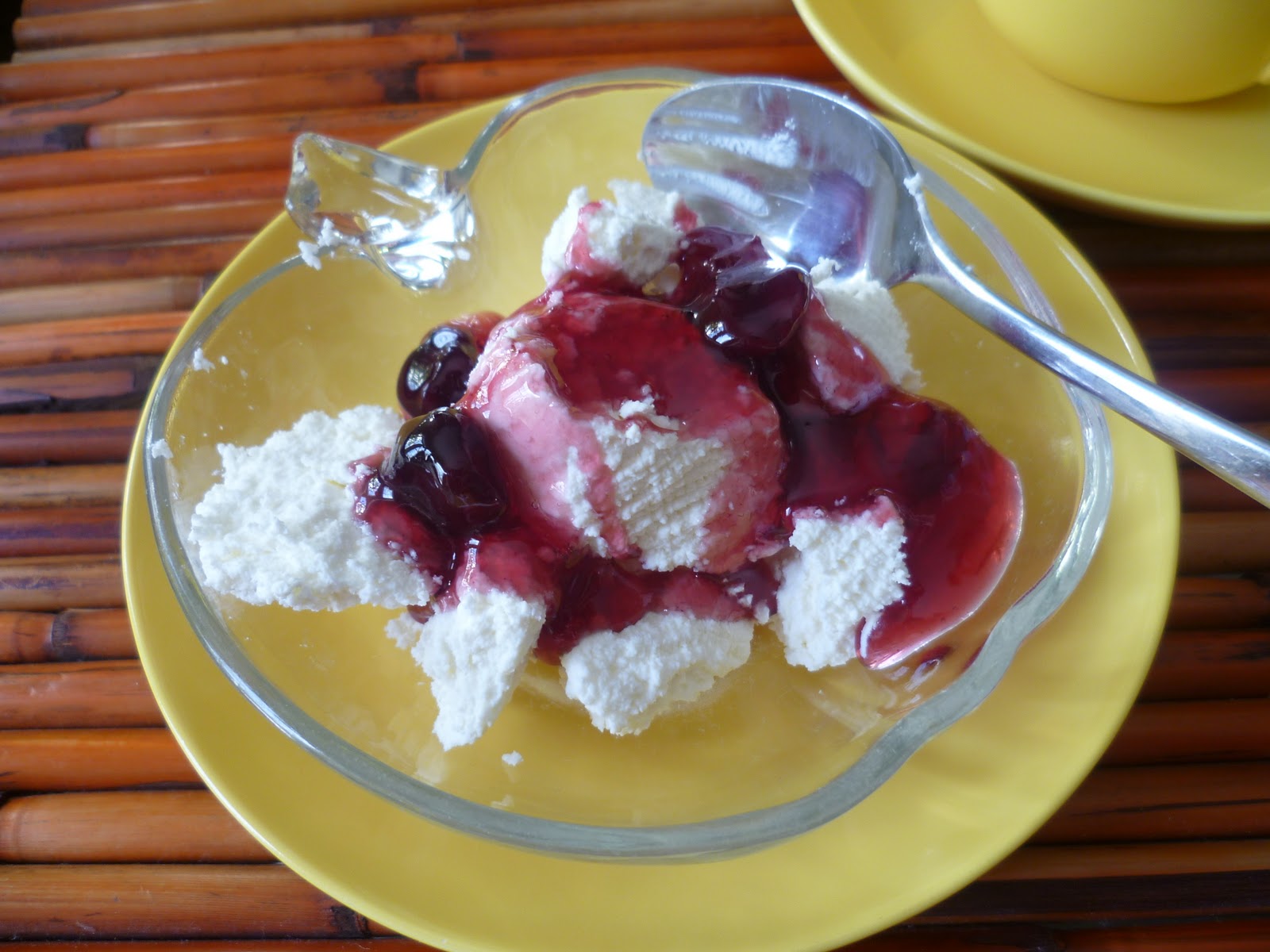
Once drained, it will keep in the fridge for up to a week to 10 days.  Use in recipes that call for ricotta, serve on its own with jam or honey or spread on crackers with a some cucumbers, radishes and a sprinkle of coarse salt.
Enjoy and take pride in the fact that you just made cheese!


My grandparent’s version of breakfast of champions.